Unpermitted Basement Finishing Risks in Minneapolis, MN: Liability and Resale Impact
If you skip permits on a basement project, the problems do not show up right away. They show up when you sell the house, file an insurance claim, or try to hire a contractor to finish work someone else started. This FAQ walks through the real unpermitted basement finishing risks for homeowners in Minneapolis, MN, in plain terms. No scare tactics, just what actually happens and what it costs to fix.
What happens if you finish a basement without a permit in Minneapolis, MN?
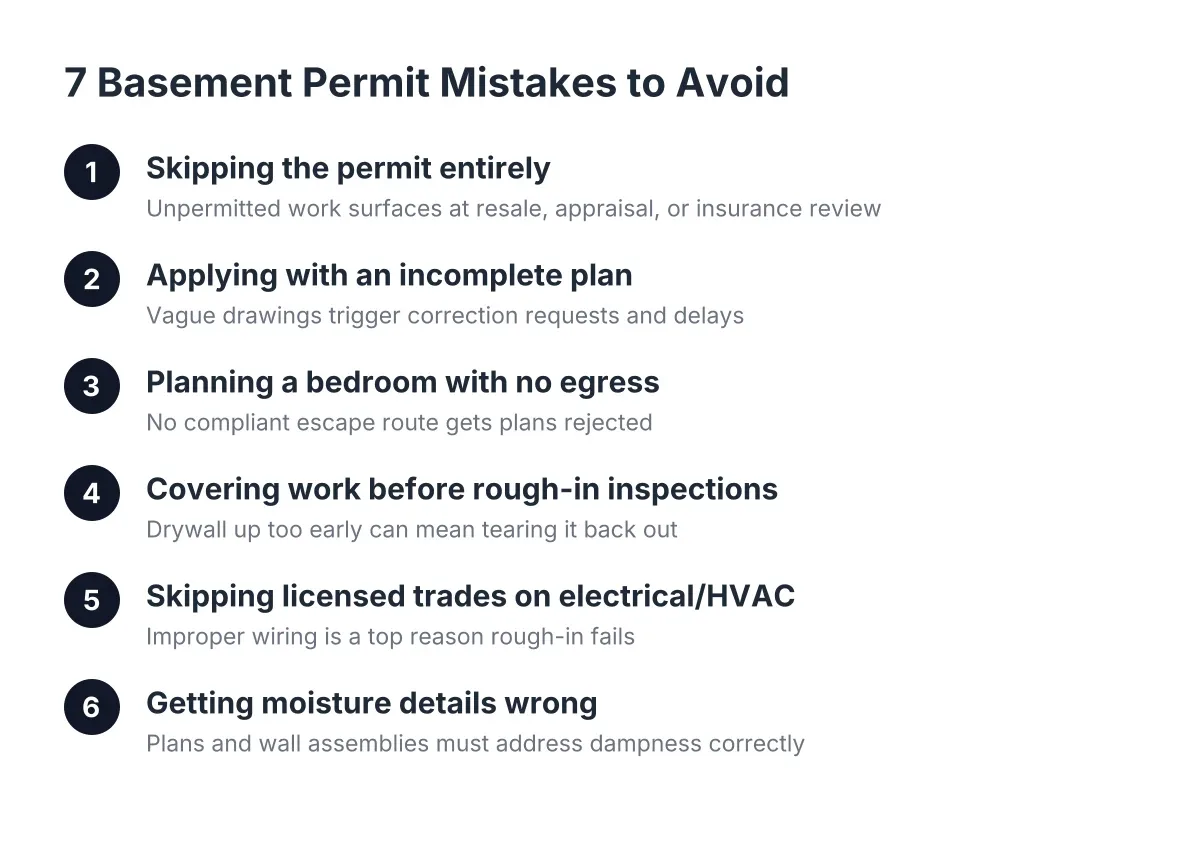
Finishing a basement without a permit in Minneapolis can lead to a stop-work order, fines, and an order to open up finished walls so inspectors can see the framing, wiring, and plumbing. The city can also require you to remove work entirely if it cannot be verified. The cost of correcting unpermitted work almost always exceeds what the permit would have cost.
In practice, unpermitted work often sits undiscovered for years. Then a neighbor calls the city, a home inspector flags it during a sale, or you pull a permit for a different project and an inspector notices the finished basement has no record. At that point you are dealing with the problem on the city's timeline, not yours.
What are the risks of unpermitted basement finishing for homeowners?
The biggest unpermitted basement finishing risks fall into four categories: safety, insurance, resale, and correction costs. A basement finished without inspections may hide undersized wiring, missing fire blocking, or bedrooms with no proper emergency exit. Those are not paperwork problems; they are the actual hazards the permit process exists to catch.
Here is the short list of what homeowners face:
- Safety hazards: wiring, gas, and venting work that no inspector ever checked
- Insurance exposure: a claim tied to unpermitted work can get complicated fast
- Resale trouble: buyers, agents, and lenders flag finished square footage with no permit record
- Correction costs: opening drywall, redoing work, and paying double permit fees after the fact
- Appraisal gaps: unpermitted finished space may not count toward the home's official square footage
Any one of these can cost more than the entire permit and inspection process would have.
Why unpermitted basement finishing risks hurt resale value
Unpermitted basement work hurts resale because buyers and their agents treat it as a liability, not an asset. In Minnesota, sellers must disclose known unpermitted work, and many buyers will either walk away, demand a price cut, or ask you to get the work permitted retroactively before closing. The finished space may also be excluded from the appraised square footage.
That is a shame, because a properly finished basement performs well at sale. According to the National Association of Realtors, 64% of basement finishing costs are recovered in a home's sale, one of the highest percentages among 20 popular projects studied. The same report found homeowners gave basement finishing a joy score of 9.5 out of 10. Permits are what protect that value. Without the paper trail, you have spent the money and cannot prove the work is sound.
Can insurance deny a claim over an unpermitted finished basement?
Insurance claims involving unpermitted basement work can get disputed, reduced, or denied depending on the policy and the cause of loss. Suppose an electrical fire starts in a basement wired without a permit or inspection. The insurer will investigate how that wiring got there, and unverified work gives them room to push back.
Even short of a denial, unpermitted work slows claims and invites scrutiny you do not want during a stressful event. For a downsizing homeowner planning to live in this house for another 15 or 20 years, that exposure compounds. This is also a spot where it pays to consult your own insurance agent, since policies vary and no contractor can tell you how your specific carrier will respond.
I bought a house with a half-finished basement. Am I liable for the previous owner's work?
Yes, once you own the home, unpermitted basement work becomes your problem regardless of who did it. The city holds the current owner responsible for bringing the property into compliance. The previous owner's shortcut, or a contractor who vanished mid-project, lands on your permit application now.
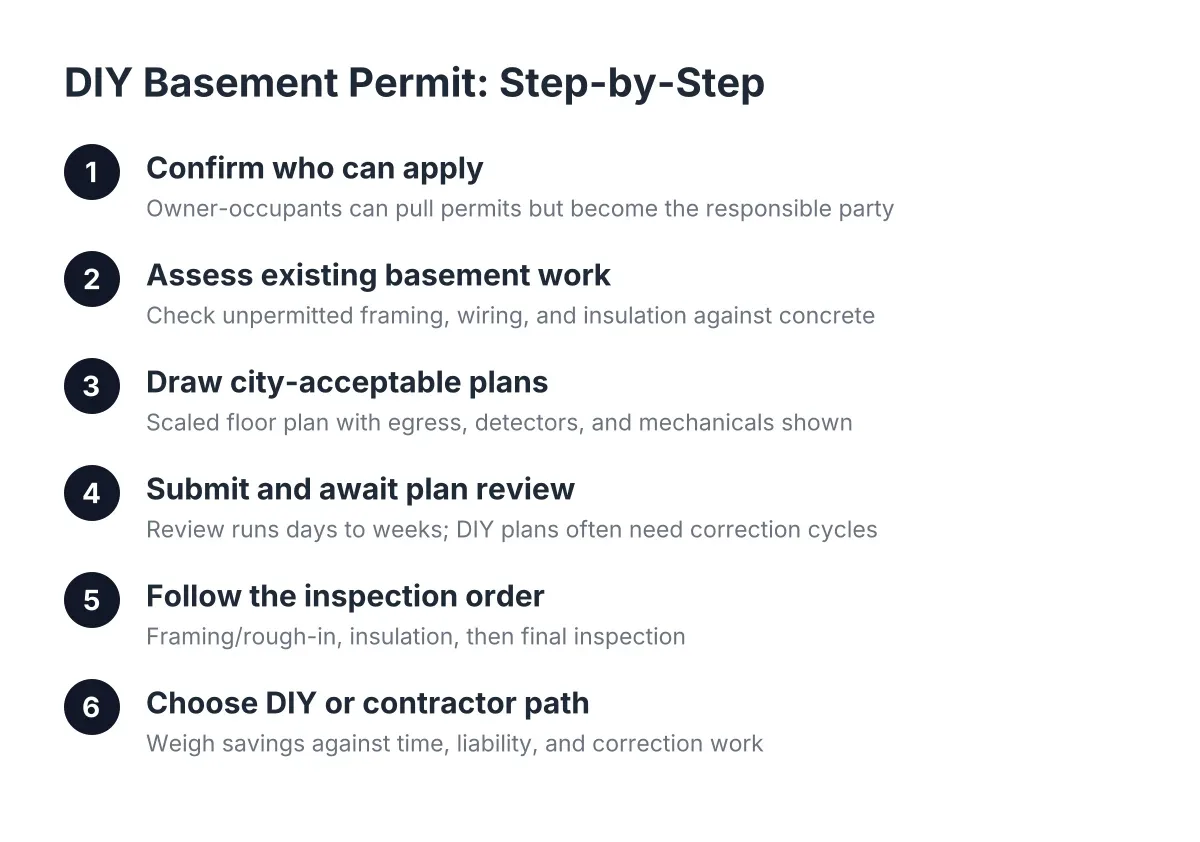
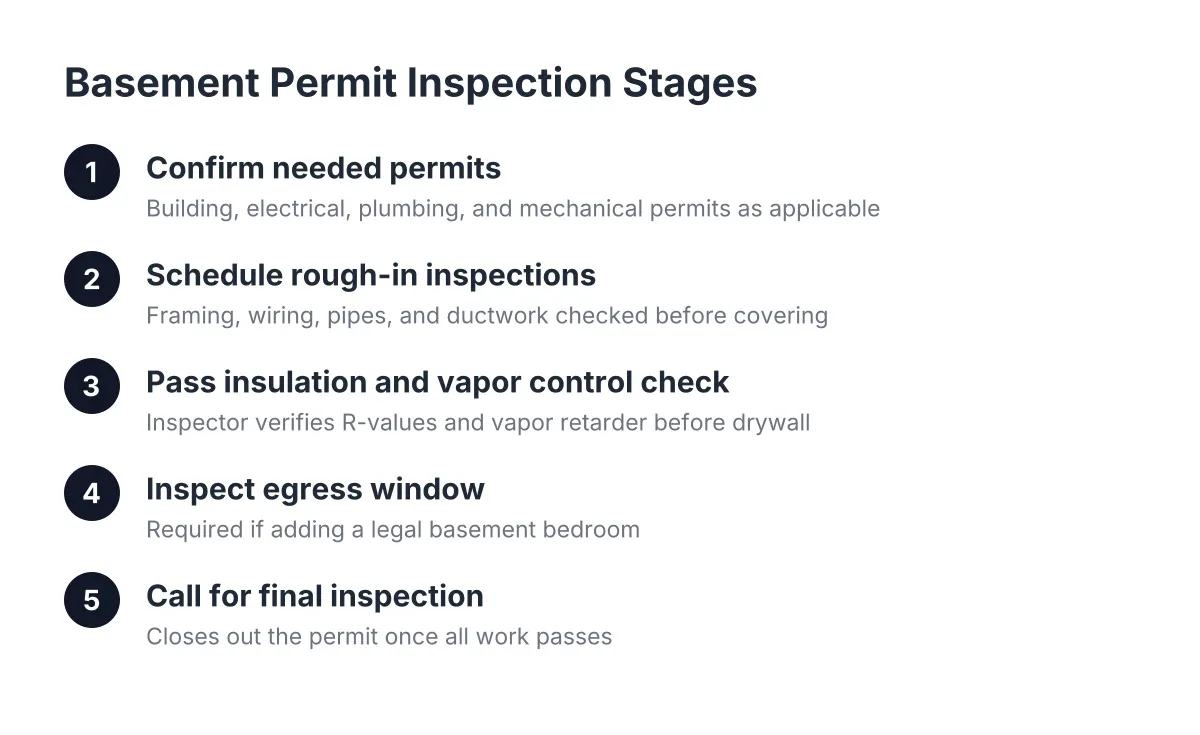
Say a homeowner in Minneapolis buys a house where the seller framed and wired half the basement, then let it sit for two years. Before anyone hangs drywall, that work needs a permit and inspections. The electrical rough-in gets inspected first, then insulation, before anything gets covered. The honest question is what can be saved versus what gets redone, and an inspector's sign-off is how you find out for sure.
Can existing framing and wiring be saved, or does it all come out?
Existing basement framing and wiring can often be kept if it meets code and can be inspected before it gets covered. Framing is usually the most salvageable part; it is visible, fixable, and inexpensive to correct. Wiring is where more problems hide, which is why the electrical rough-in inspection happens early and why a licensed electrician should review someone else's work.
Be cautious of anyone who insists on a full tear-out before even looking at what is there. A straightforward contractor will walk the space, tell you what passes, what needs correcting, and what has to go, and pull the basement finishing permits needed to get inspectors' eyes on it. That assessment, not a sales pitch, is what gets a stalled project moving again. One trade-off worth knowing: opening a few sections of drywall for inspection access costs far less than ripping everything to the studs, but it does add time to the schedule.
How do you legalize an already-finished basement?
Legalizing an already-finished basement means applying for a retroactive permit, letting inspectors verify the work, and correcting whatever does not meet code. In many cases that requires opening sections of drywall so the inspector can see framing, wiring, and plumbing connections. Expect the city to charge an investigation fee or doubled permit fee for work started without approval.
The process generally runs in this order:
- Apply for the permit and describe the existing work honestly
- Open access points in walls and ceilings where the inspector needs to see
- Correct anything flagged, often electrical, fire blocking, or venting
- Pass the required inspections, including final
- Close the permit so the record is clean for resale
It is not a fun project, but it is a known process with an end date. Living with undocumented work is the open-ended version of the same problem.
Is skipping the permit ever worth the savings?
Skipping the permit is not worth it, because the savings are small and the downside is large. As of 2026, basement permit fees in the Minneapolis area typically run a few hundred to a couple thousand dollars depending on project scope, a small slice of a project that often costs $30 to $75 per square foot, according to Angi. Weigh that against the unpermitted basement finishing risks above: a disputed insurance claim, a stalled home sale, or tearing open finished walls.
For an empty-nest couple converting the basement into a guest suite for an aging parent, the permit also buys something less obvious: proof the space is safe to sleep in. That matters more than the fee. A finished basement done with permits is an asset you can enjoy, insure, and sell. One done without them is a question mark under your house.
How do I know a contractor will actually handle the permits?
A contractor who handles permits properly will name the permits your project needs before work starts, pull them under their own license, and schedule the inspections themselves. If a contractor asks you to pull the permit as the homeowner, or suggests the project is small enough to skip it, treat that as a warning sign. Homeowner-pulled permits can shift liability for the work onto you.
Ask these questions during the estimate:
- Which permits does this project need, and who pulls them?
- What inspections happen, and at what stages?
- If existing work fails inspection, how do you price the corrections?
- Can I see the closed permit record when the job is done?
A local contractor who works Minneapolis basements regularly should answer all four without hesitation. Clear answers up front are the best predictor that someone will still be answering your calls in month three.
If you need basement finishing, Minneapolis Basement Finishing Pros can help.
Prefer to talk it through? Call (651) 758-8806 — a quick call is usually the fastest way to get a straight answer for your situation.