8 Red Flags When Hiring a Basement Contractor in Minneapolis (2026 Guide)
If you're comparing quotes to finish your basement, knowing the red flags when hiring basement contractors will save you money and months of stress. Understanding these basement contractor red flags is essential before signing any contract. Some warning signs are obvious, like a demand for full payment upfront. Others hide inside polished sales presentations from national franchise networks that route your lead to whoever is on call. This list covers eight warning signs Minneapolis homeowners should watch for, plus what a trustworthy answer sounds like in each case.
The stakes are real for a growing family. You're trying to add a bedroom, playroom, or family room without leaving your school district, and most first-time basement finishers are working with a set budget, often from a HELOC or savings. A bad contractor doesn't just waste money. He can leave you with a half-framed basement and a permit problem you inherit.
1. They Skip the Permit Conversation Entirely
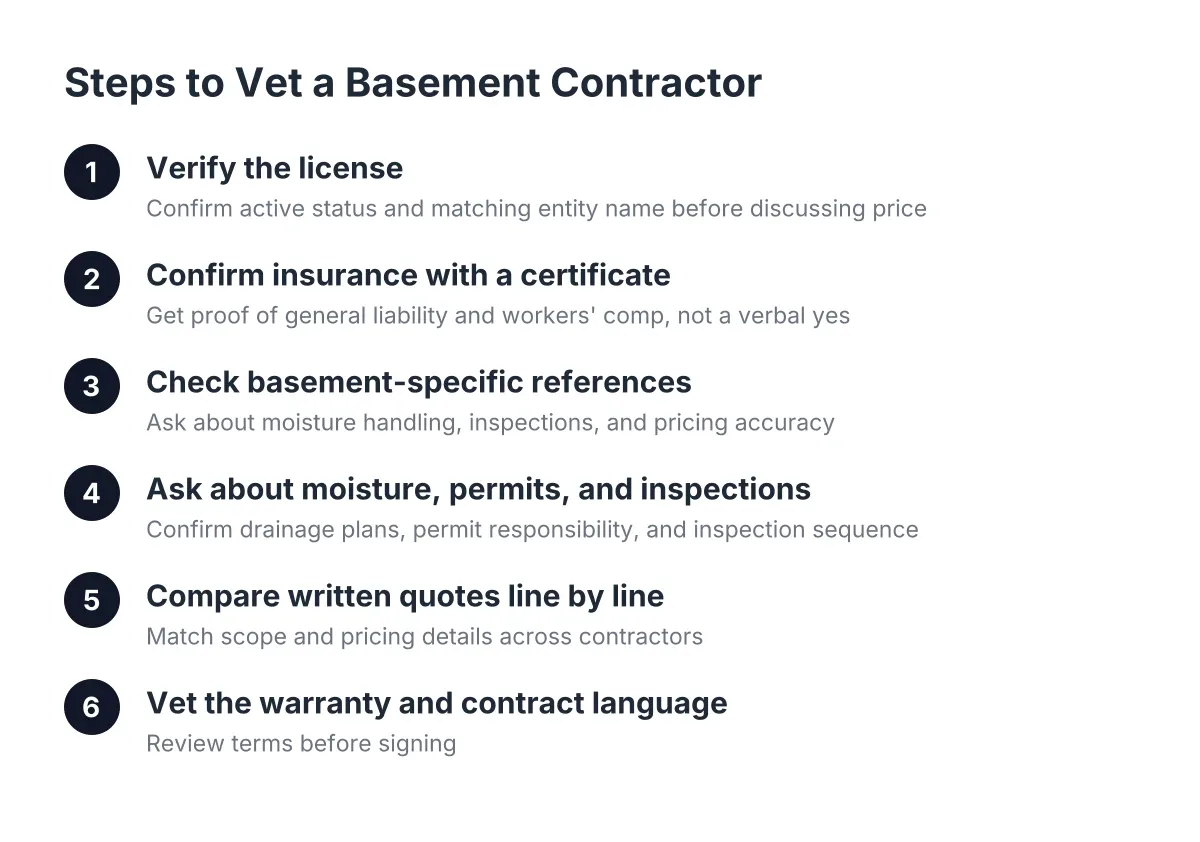
Any contractor who says you don't need a permit to finish a basement in Minneapolis, or waves the question off, is telling you how they plan to run your whole project. Finishing a basement involves framing, electrical, insulation, and often plumbing, and that work gets inspected. A contractor who dodges permits is dodging accountability.
Here's why it matters beyond the fine print. Basement projects typically require multiple inspections early on, including an electrical rough-in inspection and a separate insulation inspection later. If those never happen, problems get buried behind drywall. And when you sell the house, unpermitted finished space can complicate the sale or the appraisal.
A good contractor brings up the permit to finish a basement before you ask. He explains who pulls it, when inspections happen, and how they fit the schedule. That conversation should take five minutes and cost you nothing.
2. The Quote Is One Number With No Breakdown
A single lump-sum figure with no line items is one of the most common red flags. Hiring basement contractors means comparing scopes, not just prices, and you can't compare what you can't see. If the quote doesn't separate framing, electrical, flooring, drywall, and any basement bathroom work, you have no way to know what's included.
Vague quotes also set up the change-order trap. Suppose a Minneapolis homeowner gets a quote of $28,000 for a 700-square-foot basement finish, then learns mid-project that egress work, flooring underlayment, and drywall finishing were all "extras." That illustrative project just jumped past $40,000. For reference, Angi puts average basement remodeling cost between $30 and $75 per square foot, so a detailed quote lets you sanity-check where your number falls in that range.
Ask every contractor for a written scope with:
- Line items for each phase (framing, electrical, insulation, drywall, flooring)
- Allowances clearly stated for finishes you haven't picked yet
- A list of exclusions, in plain language
- A payment schedule tied to completed work, not calendar dates
3. Big Deposit, Vague Payment Schedule
A contractor asking for half or more of the project cost before any work starts is a serious warning sign. Reasonable deposits exist to cover materials and scheduling. However, a payment plan that front-loads most of the money removes the contractor's incentive to show up, and disappearing mid-project is exactly the fear that keeps homeowners up at night.
Look for payments tied to milestones: a modest deposit, a draw after framing and rough-in inspections pass, another after drywall, and a final payment after the punch list is done. If a contractor pushes back hard on milestone payments, ask yourself why he needs your money before he has earned it.
4. The Sales Pitch Comes From a Franchise Playbook, Not Your Basement
National basement-finishing networks standardize everything: the wall panels, the pricing script, the "today-only discount." That system works for the franchise. It works less well for a 1950s Minneapolis basement with a low-clearance beam, an old floor drain, and moisture conditions the salesperson has never dealt with, because he covers three states and got your lead from a call center.
Standardized systems can be fine for a simple, dry, rectangular basement. The trade-off is flexibility. A local contractor who knows Minneapolis basements can tell you whether your layout should work around the mechanicals, where a basement bathroom rough-in makes sense, and which flooring holds up on your specific slab. A franchise rep often can only tell you what the system includes.
One layout example worth watching for: a common inefficient plan finishes only the space to one side of the stairs and leaves the landing area as unfinished storage. That wastes the most usable square footage in the basement, right at the entry. A contractor thinking about your family's daily use catches that. A script does not.
5. Red Flags Emerge When Basement Contractors Ignore Moisture
Any basement contractor who starts picking flooring and paint colors before checking for moisture is skipping the step that determines whether your finished basement lasts. Minneapolis basements deal with freeze-thaw cycles, spring melt, and slabs of every age. Moisture has to be addressed first, or you're installing carpet over a future mold problem.
Be careful with the opposite extreme too. A contractor who insists every basement needs an expensive waterproofing package, sight unseen, is selling, not diagnosing. There's also a knowledge gap around vapor barriers. Homeowners often assume any vapor barrier stops moisture problems, but one installed in the wrong location traps moisture against framing and speeds up mold growth. The right answer depends on your slab, your walls, and how water moves around your foundation.
If your basement already has framed walls with insulation stuffed against the concrete, a straight-talking contractor may tell you to tear it out and start fresh rather than build on a bad assembly. That's a harder conversation, and a more honest one.
6. No Real Answers on Egress, Bedrooms, or Code
If you're adding a basement bedroom for a growing family, the egress window conversation has to happen before anyone signs anything. A contractor who says "we'll figure that out later" is deferring the most expensive unknown in your project. According to HomeGuide data, adding an egress window runs $3,000 to $7,000 on average, which is a meaningful line in a $15,000 to $40,000 project.
The same goes for ceiling height around ductwork, smoke and carbon monoxide detector placement, and bathroom venting. You don't need the contractor to recite code sections at the kitchen table. You need him to show that he has handled these questions in local basements before and can walk you through how inspectors will look at yours. Code details vary by situation, so confirm specifics for your home with your contractor and the city rather than relying on a general article.
7. Overpromising on Value, Timeline, or Both
Beware the contractor who promises your finished basement will "pay for itself" or be done in three weeks flat. Basement finishing is a strong project, but honest numbers matter. According to the National Association of Realtors Remodeling Impact Report, homeowners recover about 64% of basement finishing costs at resale, one of the better results among 20 projects studied. That's good, and it's not 100%.
The better argument for finishing your basement isn't resale math anyway. It's the space itself. The same NAR report found homeowners gave basement finishing a joy score of 9.5 out of 10. For a family bursting at the seams, a playroom and an extra bedroom you use every day beat a spreadsheet projection. A contractor who leads with realistic numbers on both cost and value is showing you how he'll handle every other hard conversation.
Timeline promises deserve the same scrutiny. Inspections, drying time for drywall mud, and flooring acclimation all take real days. A contractor who builds inspection windows into his schedule is planning honestly. One who guarantees a date before seeing your basement is guessing.
8. You Can't Verify Who They Actually Are
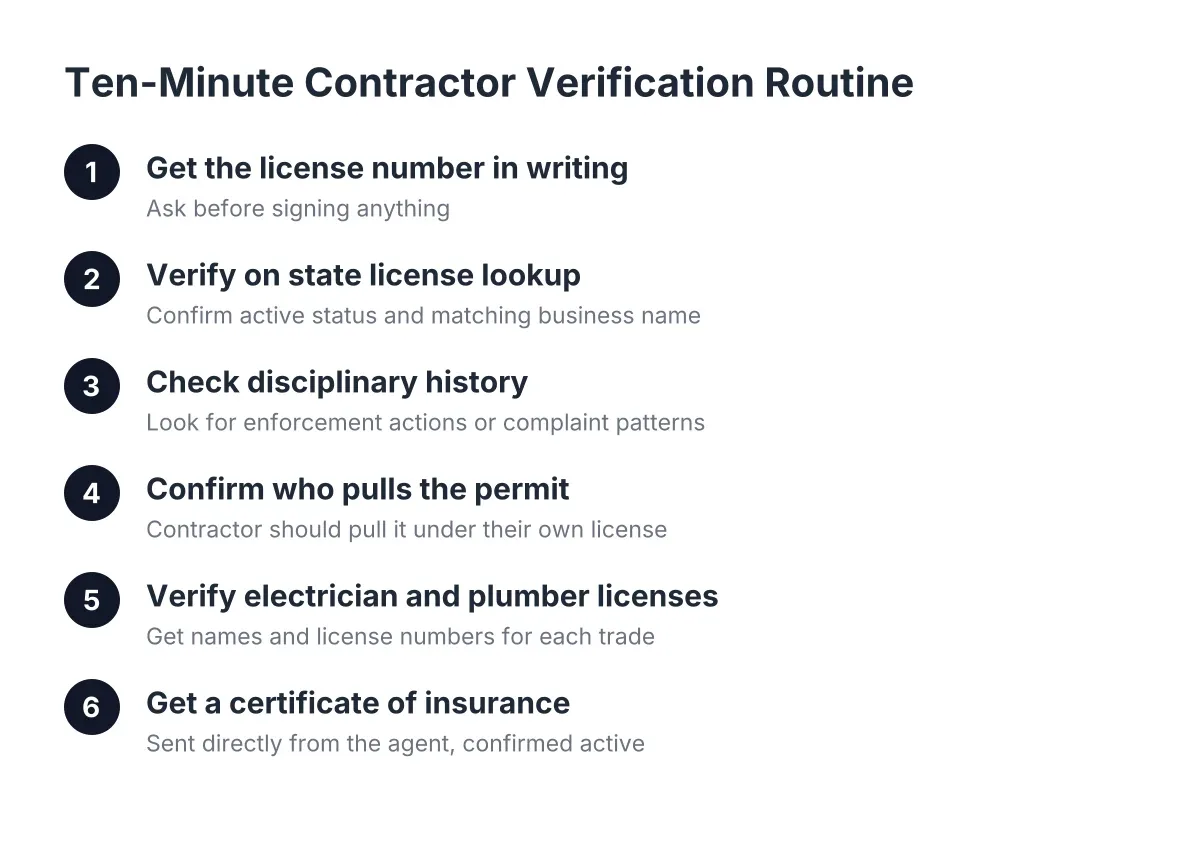
Before hiring a basement contractor, confirm the basics: a real business name, a Minnesota contractor license you can look up, proof of insurance, and local references you can call. Fly-by-night crews and lead-routing networks both fail this test in different ways. The crew has no paper trail; the network gives you a brand name but not the name of the person who will run your job.
A quick verification checklist:
- Look up the license with the Minnesota Department of Labor and Industry.
- Ask for a certificate of insurance sent directly to you.
- Request two or three local references from basement projects, and call them.
- Confirm who supervises the job day to day, by name.
- Get the warranty terms in writing, including who honors them and for how long.
That last point matters more than most homeowners realize. A basement finishing warranty from a local operator is backed by someone whose reputation lives in your area. A franchise warranty may depend on whether that territory owner is still in business in five years.
How These Red Flags Show Up When You Compare Quotes
The clearest red flags in hiring basement contractors surface when you put three quotes side by side. One bid that's dramatically lower usually means a thinner scope, not a better deal. One that pressures you to sign tonight is protecting its price from comparison. The quote worth trusting explains its own numbers, names its exclusions, and holds up when you ask questions.
For example, say a homeowner collects three bids for a basement with a future bathroom planned. The lowest bid never mentions the plumbing rough-in. The highest bundles a waterproofing system she may not need. Additionally, the middle bid phases the project, roughs in the bathroom plumbing now, and prices the bathroom finish as a later phase. That middle contractor listened; the layout and phasing fit how the family actually plans to use and pay for the space.
None of these warning signs alone proves a contractor is bad, and a single miss deserves a follow-up question, not an automatic rejection. Nevertheless, two or three red flags together form a pattern. Trust the pattern. Your basement is going to be your kids' playroom, your guest bedroom, or the family room where you finally spread out. Pick the contractor who treats it that way, gives you straight answers on layout, flooring, moisture, and permits, and puts every promise in writing before the first wall goes up.
If you need basement finishing, Minneapolis Basement Finishing Pros can help.
Prefer to talk it through? Call (651) 758-8806 — a quick call is usually the fastest way to get a straight answer for your situation.